
2026.02.23
Swedish efficiency without compromise in Frankfurt
Process control, intelligent automation and long-term industrial reliability remain the shared priorities that continue to define members of TMAS, the Swedish textile machinery association.
“Across different stages of textile and material production, TMAS members are united by a common belief that productivity begins with stability,” says TMAS General Secretary Therese Premler-Andersson. “Rather than focusing on isolated machine functions, the emphasis is on controlling the critical variables that directly influence quality, efficiency and uptime.”
Concrete examples of this approach will be demonstrated at Messe Frankfurt’s forthcoming Techtextil and Texprocess exhibitions taking place concurrently in Frankfurt from April 21-24.
Operational value
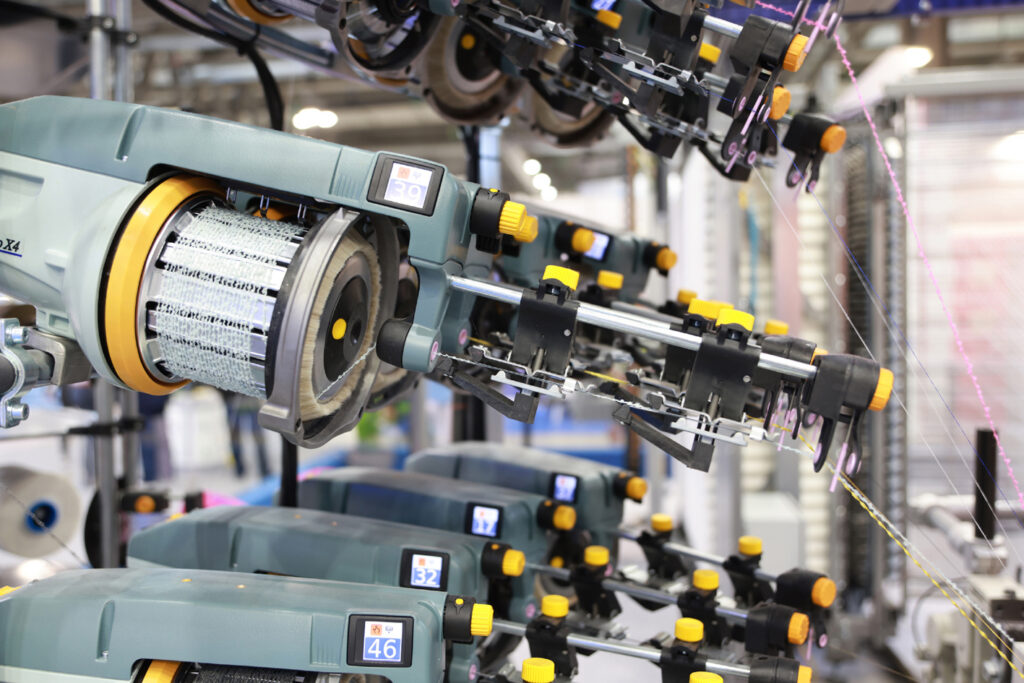
In weaving and related processes for example, Vandewiele Sweden AB has long-standing expertise in weft feeding and tension control. At Techtextil 2026 in Hall 12 stand C21, company experts will be on hand to explain how, through ensuring repeatable, predictable yarn delivery at ever higher loom speeds, it is enabling weaving mills to operate closer to their technical limits while maintaining fabric quality.
The company’s continued development of data-ready weft feeders reflects a broader approach to digitalisation, embedding intelligence where it delivers clear operational value rather than adding complexity to already demanding production environments.
Quality assurance
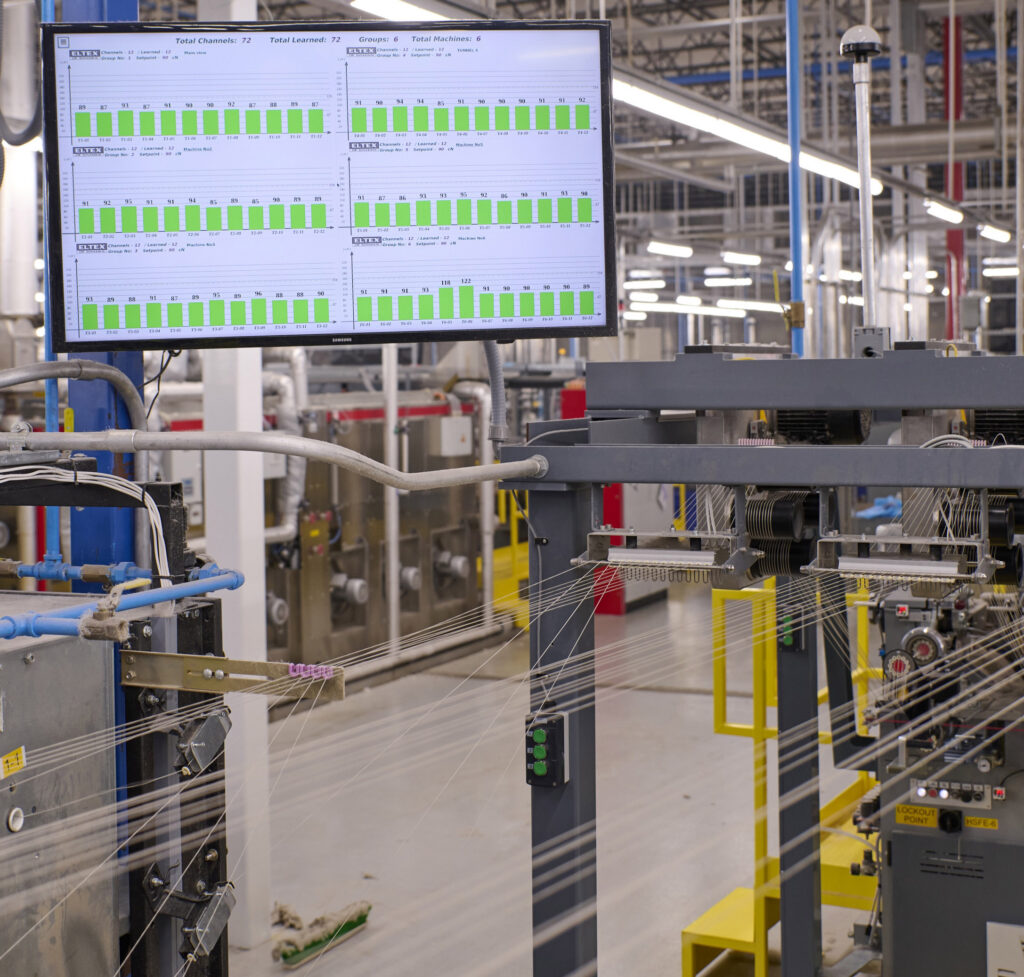
Eltex of Sweden addresses the same challenge from a complementary angle. Its electronic yarn sensors and tension monitoring systems focus on early detection, identifying yarn breaks, end-outs or abnormal tension before they lead to waste, downtime or quality claims. From weaving and warping through to tufting, braiding, quilting and sewing, Eltex technology provides the assurance that modern automated processes depend on. As production speeds increase and manual supervision is reduced, the ability to monitor yarn behaviour in real time becomes a key enabler of stable, high-quality output.
At Techtextil 2026 (Hall 12.0, stand C53), Eltex will highlight its latest EyETM Multiact system for heat setting machines, guaranteeing yarn consistency throughout the entire process via individual yarn tension monitoring and control according to a predefined reference tension.
Each channel operates independently and the system also includes a machine stop function in the event of yarn breakage or if yarn tension operates outside preset limits.
Also showcased, will be the ACT-R system for rapier weaving machines which is highly effective in achieving constant weft yarn tension for yarns based on recycled fibres at one end of the scale, and for expensive technical yarns such as Kevlar at the other.
Consistency
Further downstream, BW Converting, in Hall 12.0, stand C56B at Techtextil 2026, extends this focus on control and assurance into dyeing and finishing.
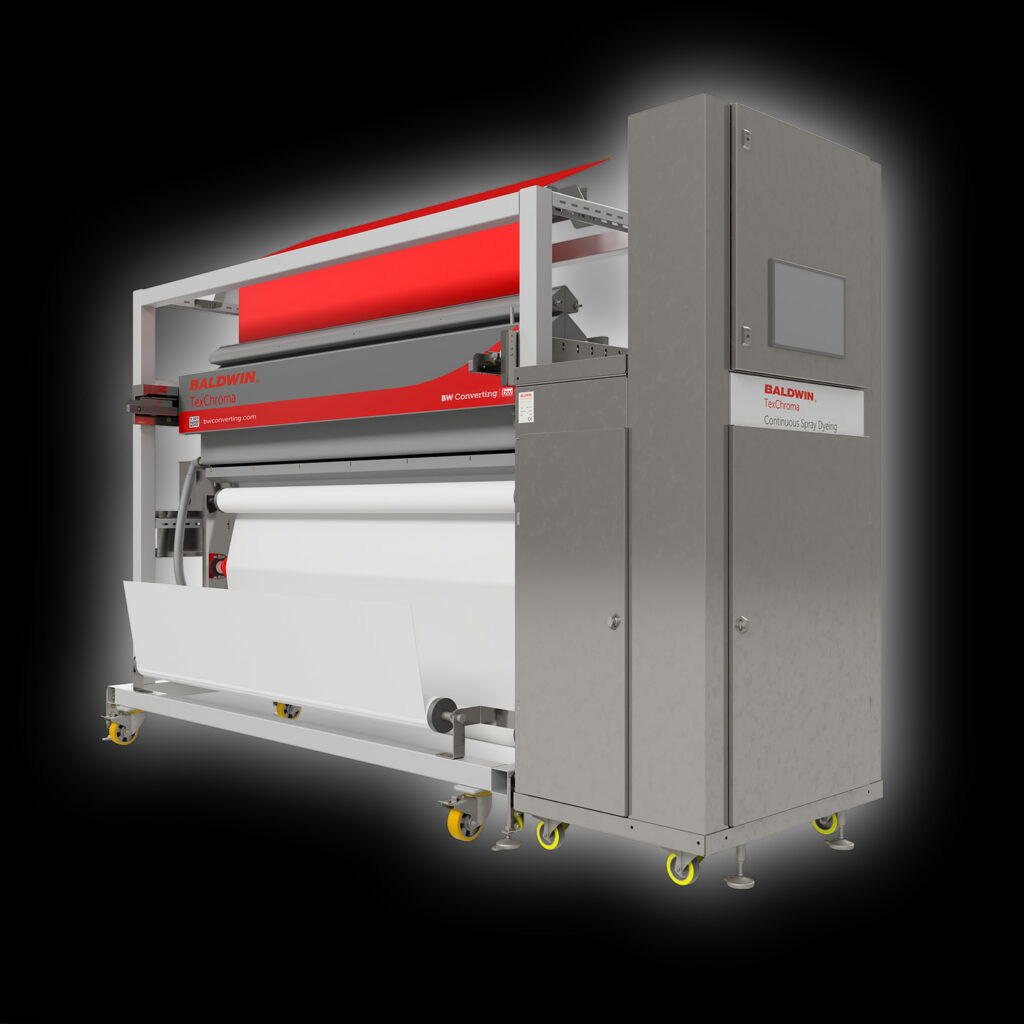
Following the runaway success of the company’s Baldwin TexCoat G4 finishing system in the past few years, the Baldwin TexChroma digital spray dyeing system is currently being launched.
“Since its introduction, global textile finishers have embraced TexCoat and are now reaping the benefits,” says vice-president of global business development Rick Stanford. “They have been able to increase profitability, cut energy use and reduce their carbon footprint, in addition to exercising precision control with our patented precision spray technology. In the past two years we have been very active in Asia, and many of these customers have been asking for a similar technology for the dyeing process.”
From production data to date, TexChroma can achieve savings in energy, dyes and chemicals of more than 30% compared to conventional continuous pad batch dyeing using steam, and up to 50% compared to exhaust reactive dyeing.
It also benefits from an advanced technology enabling reactive dyestuffs and alkali fixation chemicals to be mixed just seconds before spray application, in order to completely eliminate any ‘tailing and listing’– uneven dye application or colour variations.
Eton aUPS
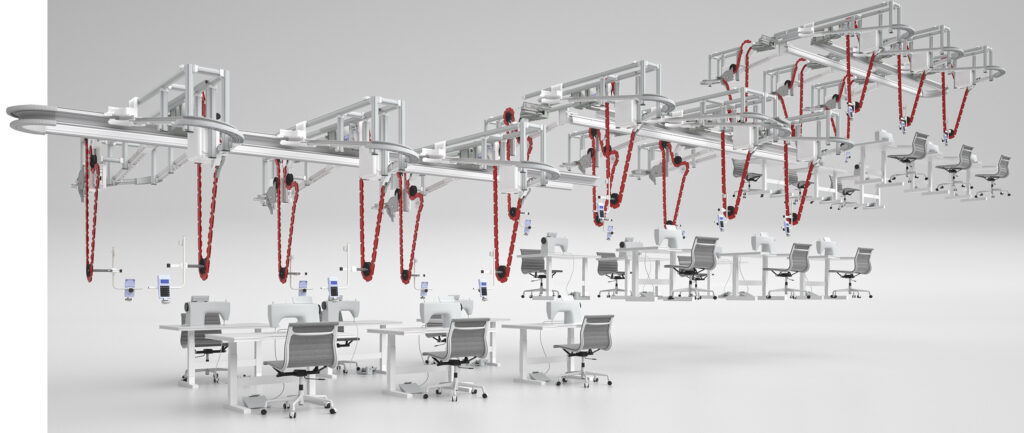
Meanwhile, at Texprocess in Hall 8 at stand B38, Eton Systems will outline how Industry 4.0 and AI are further boosting the capabilities of its aUPS (AI powered unit production system) technologies.
Eton Systems productivity and management system have a positive impact on the productivity of thousands of production lines for a range of industries. Designed to increase value-added time in production by eliminating manual transportation and minimising handling, the individually addressable product carriers are now fully managed and controlled by the company’s advanced software.
The UPS works perfectly for mass production but provides companies with an extra competitive edge through its ability to quickly respond to special custom- made orders – even without disrupting an ongoing larger production batch. The aUPS is developed for circular garment identification, but the ambition is also to cover quality control in future linear production.
The individually addressable product carriers of these fully automated and digitised handling solutions for finished garments, home textiles and furniture are fully managed and controlled by the latest ETONingenious™ software.
This web based real-time data collection and information system continuously accumulates, processes, and makes all production information instantly available to supervisors, quality control personnel, and management.
Precision slitting
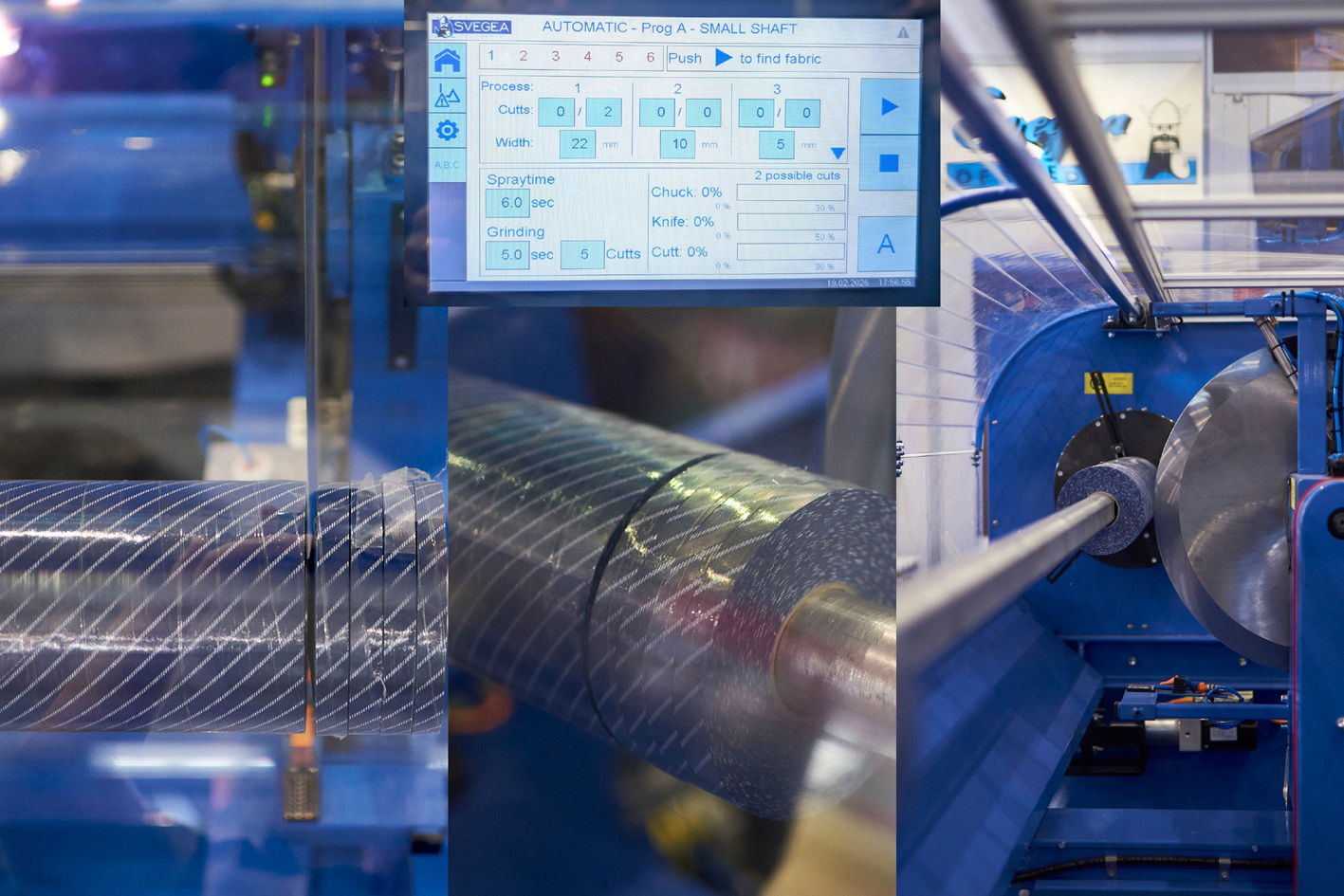
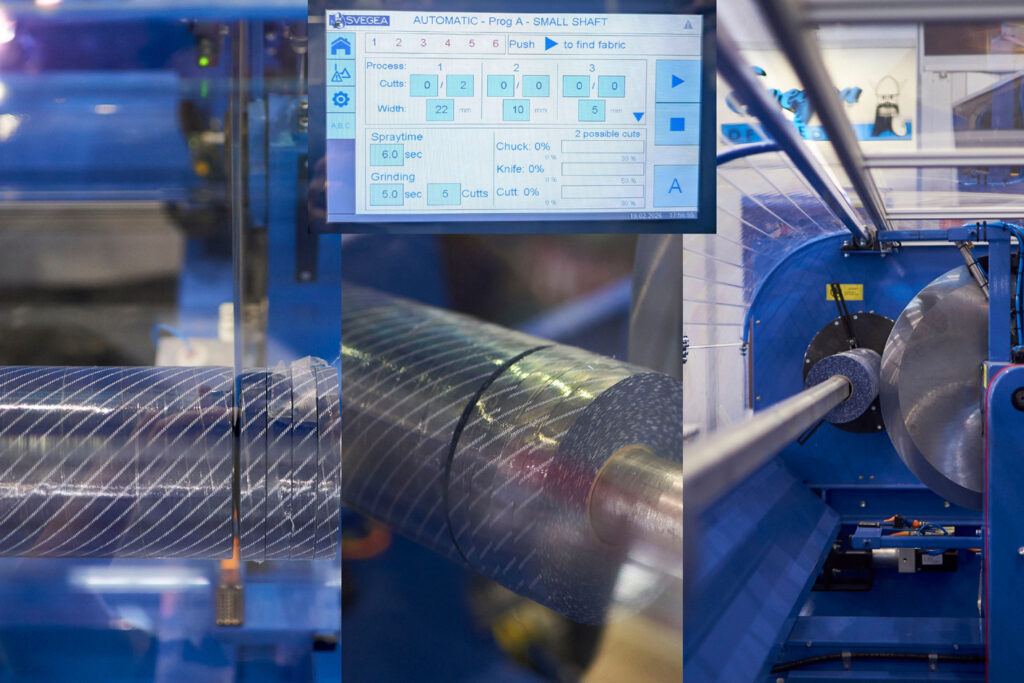
Also at Texprocess in Hall 8.0, at stand C43, Svegea will demonstrate its EC 200-C colarette cutter as well as an FA 350 fully automatic roll slitting machine.
Svegea’s colarette technology is used by knit garment manufacturers around the world for the production of tubular components such as cuff and neck tapes and other seam reinforcements.
“In Europe, while the garment manufacturing sector is relatively limited in size, interest in these machines has increased in recent years, mainly driven by logistics, cost and lead-time considerations as production moves closer to the market,” says Svegea Managing Director Håkan Steene. “The ongoing shortage of skilled operators has also increased the demand for such automated solutions.”
Svegea’s fully automatic FA 350 roll slitting machine meanwhile addresses a wider range of needs for roll conversion within the technical textiles sector, combining high capacity with very low power consumption and providing extremely accurate cutting precision. Capable of cutting both knitted and woven fabrics – including those produced from a wide range of technical fibres – it can accommodate different shaft sizes and is fully electronically controlled with servo motors. The touchscreen interface has recently been redesigned and expanded with new functions, including automatic control of the knife surface speed during the cutting cycle, maintaining consistent cutting conditions as the roll diameter decreases for improved cutting quality and material handling.
Bespoke bias cutting systems are another speciality of the company, for specifically contoured technical textile-based components.
Essential foundation
A second theme linking all TMAS members in Frankfurt is a shared response to the economic realities facing textile manufacturers worldwide.
“Rather than promoting automation as an abstract objective, Swedish machinery suppliers focus on tangible productivity gains that help manufacturers in high-cost regions remain competitive,” says Premler-Andersson. “Reduced waste, higher uptime and repeatable quality are the essential foundations for sustainable manufacturing.
Techtextil 2026
Vandewiele Sweden: hall 12 stand C21
Eltex of Sweden: hall 12.0, stand C53
BW Converting: hall 12.0, stand C56B
Texprocess 2026
Eton Systems: hall 8 at stand B38
Svegea: hall 8.0, at stand C43
For further information please contact:
Therese Premler-Andersson
Secretary General, TMAS
Phone: +46 8-782 08 50
E-mail: office@tmas.se